
Water makes up more than 90% of many water-dilutable coolant solutions, so its quality can directly affect coolant performance, tool life and surface finish.
Even facilities using the same coolant and mixing process may get different results because their water contains different levels of minerals, salts, suspended material and microorganisms. Instead of guessing, test the source and makeup water and compare the results with the coolant supplier’s requirements.
Hard water can leave more than scale
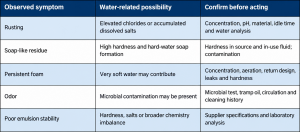
Hardness is primarily associated with dissolved calcium and magnesium. In metalworking fluids, those ions can react with formulation components and form insoluble material commonly described as hard-water soap. Visible clues may include scum, sticky residue or deposits on machines and parts. As hardness builds, it may also reduce emulsion stability, corrosion protection and biological resistance.
Here is a shop-floor example: A team repeatedly cleans a waxy film from a machining center and assumes the coolant is simply “dirty.” A better troubleshooting path is to record concentration, inspect for tramp oil and chips, and test both source water and the in-use fluid for hardness. If hardness is elevated, the residue may be a water-chemistry issue rather than a housekeeping issue alone.
Very soft water can create a different problem
Low-mineral water may reduce hard-water deposits, but it can also make some formulations more prone to foam. Foam can also be driven by mechanical agitation, air leaks, excessive flow or incorrect concentration, so it should not be diagnosed from water hardness alone. The useful question is: Did foam begin after a water-source change, treatment-system change or fresh charge?
Dissolved salts raise corrosion concerns
Chlorides and sulfates do not evaporate with the water. As water leaves a recirculating system and makeup water is added, dissolved contaminants can remain and accumulate. Technical references associate chlorides with corrosion risk and sulfates with staining and sulfate-reducing bacteria.
For a maintenance manager, that means rust on parts should trigger a broader review: coolant concentration, pH, contamination, material compatibility, idle time and water chemistry. A chloride test can help determine whether the incoming or makeup water is contributing to the condition. It does not replace a complete root-cause investigation.
Microorganisms can arrive with water
Bacteria and fungi may be present in municipal, well, process, reverse-osmosis or deionized water systems. If microbial populations increase in the sump, coolant stability, corrosion protection, odor and service life may be affected. Water is only one possible source. Tramp oil, chips, poor circulation and inadequate system cleaning can also contribute to biological problems.
Why makeup water deserves attention
A system does not lose dissolved minerals when water evaporates. Repeated water additions can therefore increase the concentration of hardness and salts in the circulating fluid. This “distillation effect” helps explain why a fresh charge can perform well at startup but develop residue, stability or corrosion problems later.
A practical water-quality troubleshooting routine
1. Define the symptom. Document when it started, which machines or shifts are affected and whether the source water, treatment equipment, coolant, makeup practice or operating conditions changed.
2. Verify the basics. Measure coolant concentration and the parameters specified by the coolant supplier. Inspect for tramp oil, chips, restricted return flow, leaks and excessive aeration.
3. Test the water. At minimum, discuss hardness, conductivity or total dissolved solids, chlorides, sulfates, pH, alkalinity, suspended solids and microbial quality with the coolant supplier or qualified laboratory. The required list and acceptable limits depend on the product and application.
4. Compare source and system samples. A source-water sample shows what enters the system. An in-use sample can reveal accumulation or contamination. Label the sampling point, date and operating condition.
5. Act with technical guidance. Do not select softening, reverse osmosis, deionization, blending or biocide treatment based on a generic threshold. Review test results with the coolant supplier and a water treatment specialist before changing the process.
6. Document the results. Record the corrective action and follow-up measurements. This builds a facility-specific knowledge base and makes recurring problems easier to recognize.
What the symptom may be telling you
Build water quality into coolant reliability
Water-quality testing will not explain every coolant problem. It can, however, remove a major unknown from the investigation. When teams establish a baseline, trend the working solution and evaluate results with product-specific guidance, they are better equipped to separate water-related effects from mechanical, operational and contamination issues.
AMSOIL Industrial approaches coolant troubleshooting as a system problem. The fluid, water, machine, process and maintenance practices all matter. That broader view supports decisions based on evidence and data instead of repeated trial and error.
Coolant problems? Download the Water Quality Troubleshooting Guide for a symptom-based checklist or contact an AMSOIL Industrial Application Engineer.
Frequently asked questions about water quality and water-based coolants
How does water quality affect water-based coolant performance?
Water makes up most of a typical water-dilutable coolant working solution, so its hardness, dissolved salts, suspended material and microbial condition can influence emulsion stability, corrosion protection, residue, foam and coolant service life.
What water-quality tests are useful for metalworking fluids?
Testing commonly includes hardness, conductivity or total dissolved solids, chlorides, sulfates, pH, alkalinity, suspended solids and microbial quality. The coolant supplier or a qualified laboratory should define the required tests and acceptable limits for the specific product and application.
Can hard water cause residue in a coolant system?
Yes. Calcium and magnesium can react with formulation components and form insoluble material often described as hard-water soap. Possible signs include scum, sticky film or deposits, but concentration, tramp oil, chips and other contamination should also be checked before identifying the cause.
Can soft water make a water-based coolant foam?
Very soft water may make some coolant formulations more prone to foam. Mechanical agitation, air leaks, excessive flow and incorrect concentration can also cause foaming, so water hardness should be evaluated as part of a broader troubleshooting review.
| *Technical properties are general characteristics of the product and not manufacturing specifications. Variations that do not affect product performance should be expected. Product formulations are subject to change without notice. Customers are responsible for determining product suitability for use with their equipment. |