
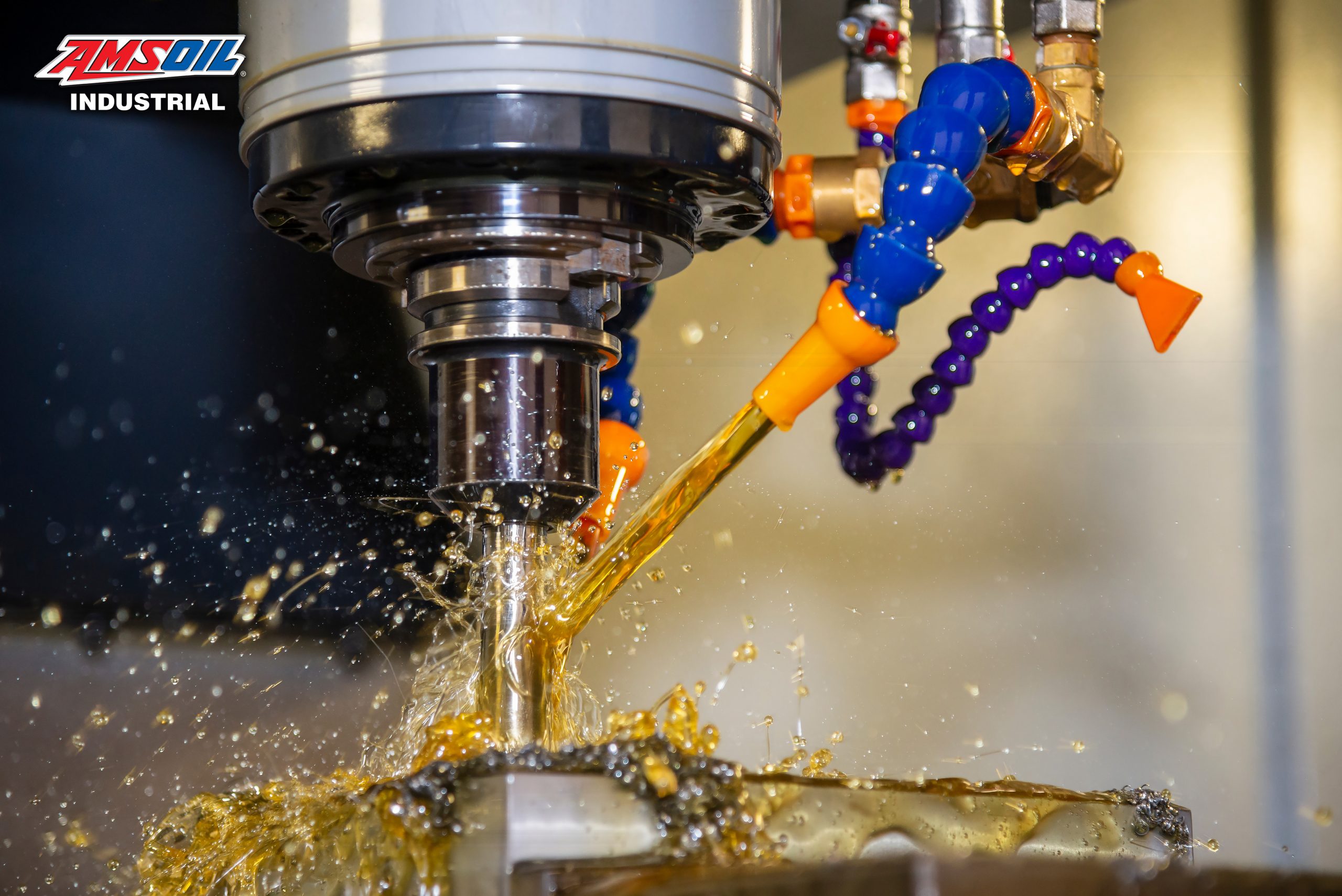
Straight oils are commonly used in metal removal operations where lubrication, surface integrity and tool protection are prioritized over cooling. Within this category, viscosity selection plays a direct role in machining efficiency, tool life and process stability. Viscosity determines how effectively the oil forms a lubricating film, penetrates the cutting zone, removes heat and transports chips away from the tool-workpiece interface. Selecting the correct viscosity aligns fluid performance with speed, load and material demands.
High or Low Viscosity
Lower-viscosity oils flow more readily into the cutting zone, particularly with high surface speeds and tight clearances. Their lower internal resistance to flow allows rapid wetting of the tool-part interface and consistent delivery through spray or mist systems. They also enable increased circulation to minimize fluid stagnation and improve heat transfer away from the cutting edge.
The ability to drain quickly from the cut zone provides faster chip evacuation in high-speed machining, which prevents chip packing and recutting that can degrade surface finish and accelerate tool wear. Lower fluid drag also reduces power consumption and provides reliable spindle performance at elevated speeds.
Higher-viscosity oils form thicker, more robust lubricating films under increased loads. Increased film strength improves separation between the tool and workpiece, reducing friction and wear in operations involving high pressures, interrupted cuts or slow surface speeds.
All viscosities are also supported by extreme-pressure additives for maximum protection against scuffing, galling and micro-welding in demanding metal removal processes. However, heat dissipation and reduced fluidity must be managed through proper application methods.
Low-Viscosity Straight Oil
• Faster heat removal
• Improved chip evacuation
• Lower power draw
• Effective at high speeds.
High-Viscosity Straight Oil
• Stronger lubricating film.
• Improved load protection.
• Enhanced tool life under severe conditions.
Straight Oil Benefits
Cooling
Straight oils remove heat primarily through convection rather than evaporation. Lower-viscosity oils circulate more effectively, continuously transporting heat away from the cutting zone. This improves thermal stability in high-speed turning and milling where heat generation is rapid and localized.
Higher-viscosity oils retain heat longer due to reduced flow and higher internal friction. In slow-speed or heavy-load operations, this tradeoff is acceptable because lubrication and surface protection outweigh maximum cooling demands. Excessive viscosity, however, can elevate cutting temperatures and accelerate oxidation if not properly controlled.
Chip Evacuation
Chip evacuation depends on fluid flow and the ability to flush chips from the cutting interface. Low-viscosity oils promote rapid chip transport and reduce chip adhesion to tools and workpieces. This improves dimensional consistency and surface finish in continuous cutting operations.
High-viscosity oils resist flow, which can limit chip removal in deep cavities or blind features. In these applications, targeted delivery methods and pressure-assisted flow are required to maintain clean cutting conditions.
Lubricity
Viscosity directly influences oil film thickness. Higher-viscosity oils maintain a stable lubricating layer that reduces friction and minimizes direct metal contact under load. This supports improved tool life and reduced edge chipping in severe machining environments.
Lower-viscosity oils rely more heavily on additive chemistry to provide boundary lubrication. When properly formulated, they still deliver effective friction control while maintaining fluid mobility at elevated speeds.
Load Protection
Load protection increases with viscosity as film strength improves. High-viscosity oils resist film collapse under pressure, protecting cutting edges and minimizing surface damage. Low-viscosity oils provide sufficient protection in high-speed, low-load conditions but may thin excessively under heavy cutting forces if improperly selected.
Application Recommendations
High‑Speed Turning and Milling
Improved flow supports cooling and chip evacuation while reducing drag and heat generation at the spindle. Low‑viscosity straight oils are preferred to maintain surface finish consistency and enable higher feed rates and tight clearances without sacrificing tool life.
Deep‑Hole Drilling and Tapping
Thicker films protect tool flanks and threads while reducing torque and breakage risk. Pressurized delivery improves penetration and chip removal. Moderate- to high‑viscosity oils are effective where lubricity and load-carrying capacity are required.
Broaching and Gear Cutting
Enhanced lubricity reduces friction and supports dimensional accuracy across extended production runs. High‑viscosity straight oils provide the film strength required for continuous contact and high loads.
Hard and Exotic Metals
Machining hardened steels, nickel alloys and titanium requires oils with sufficient viscosity to maintain film integrity under extreme pressure. Higher-viscosity formulations combined with robust additive systems reduce tool wear and stabilize cutting conditions in materials with high thermal loads.
Additional Applications
• Thread forming: High-viscosity oils support surface integrity and tool protection.
• Sawing: Moderate-viscosity oils balance cooling and lubrication.
• Shaping and slotting: High-viscosity oils improve load protection during interrupted cuts
Complete Metalworking Solutions
An integrated approach to metalworking fluid selection and maintenance maximizes machining efficiency, reliability, tool life and parts consistency while protecting valuable equipment and reducing total operating costs.
AMSOIL Industrial formulates metalworking fluids to deliver advanced protection and precise performance in demanding metal removal applications. Contact an AMSOIL Industrial Application Engineer and discover how easy it is to optimize fluid selection, application methods and maintenance practices to reduce costs, maximize productivity and meet your specific operational goals.
| *Technical properties are general characteristics of the product and not manufacturing specifications. Variations that do not affect product performance should be expected. Product formulations are subject to change without notice. Customers are responsible for determining product suitability for use with their equipment. |