
Lubrication Logic | A practical guide to matching your lubricant supply format to how your operation actually runs.
For most operations, lubricant decisions stop at the product: the right viscosity, the right additive package and the right performance specification. But how that lubricant arrives, gets stored and reaches the machine has just as much influence on cost, uptime and cleanliness as the formulation itself. The choice between packaged products and bulk delivery is one of the most consequential — and most overlooked — decisions in a lubrication program.
The goal of this guide isn’t to push one format over another. It’s to help you read your own operation honestly and recognize the signals that indicate your current delivery method may no longer fit your needs. A well-matched supply format reduces waste, protects fluid cleanliness and frees your maintenance team to focus on equipment instead of managing containers.
The real cost question: Look beyond price per gallon
Most procurement decisions are made on price per gallon, but that number tells only part of the story. The true measure is total cost of ownership (TCO): the full set of costs that follow a lubricant from delivery to disposal. Once you account for everything, the economics often look very different from the line item on the invoice.
A complete TCO view of any lubricant supply format should include:
• Handling labor – the staff hours spent receiving, moving, staging and dispensing containers.
• Storage footprint – the floor space consumed by drums and pails versus a dedicated tank.
• Waste and disposal – the cost of managing empty containers, residual product and packaging waste streams.
• Contamination risk – the downtime and repair costs that follow when dirty or mixed fluid reaches a machine.
• Inventory carrying cost – the value tied up in safety stock and the risk of using expired or wrong product.
A lubricant that looks cheaper by the gallon can cost more once handling labor, disposal fees and the risk of contamination are factored in. Conversely, a format with a higher setup cost can pay for itself when it removes recurring labor and waste from the equation. The point isn’t that bulk always wins or packaged always wins, it’s that the right answer depends on the full picture of how your facility operates.
Packaged lubricants: Where they still win
Packaged products (pails, drums and totes) remain the right choice for a large share of operations. Their core advantage is flexibility: they require minimal setup, can be deployed immediately and support a decentralized approach where different lubricants live close to the equipment that uses them.
Packaged delivery tends to be the better fit when:
• Annual consumption is modest – generally under about 500 gallons, where a bulk tank would sit largely idle.
• You manage many lubricant types – a wide variety (often more than 15 products) is hard to justify in dedicated tanks.
• Storage space is limited – packaged product can be distributed across the plant without a dedicated containment area.
• Usage is intermittent or specialized – low-turnover or shelf-life-sensitive fluids (such as some greases) are better bought in smaller quantities.
• Setup capital is constrained – there’s no tank, pump or filtration investment required to get started.
The trade-off is that packaged formats carry recurring costs that scale with volume: more containers to handle, more packaging to dispose of and more opportunities for the wrong product to be grabbed in a hurry. For a smaller or highly varied operation, that trade-off is usually worth it. As volume grows, it can become a drag.
Bulk delivery: When it becomes the smarter system
Bulk delivery — product supplied to on-site tanks and dispensed as needed — changes lubrication from a series of transactions into a managed system. Its advantages compound as scale increases: lower cost per gallon, far less packaging waste, reduced handling labor and tighter inventory visibility.
Bulk delivery typically becomes the stronger option when:
• Consumption is high and steady – typically above 2,000 gallons per year, where volume pricing and reduced order frequency deliver real savings.
• You standardize on a few core lubricants – a consolidated slate (fewer than about six high-volume products) maps cleanly to dedicated tanks.
• You have space for a dedicated storage area – room for tanks, pumps and proper filtration and containment.
• Container handling labor is high – staff is spending meaningful time moving, staging and emptying drums.
• Packaging waste and sustainability goals matter – bulk eliminates most single-use containers and supports waste-reduction targets.
• Inventory visibility is critical – tank-level monitoring gives a clear, real-time picture of what you have and when to reorder.
Bulk does require upfront planning: tank design, dispensing equipment, filtration and contamination controls. But for high-volume, consistent operations, that investment is repaid through lower per-gallon cost, less waste and a more reliable, better-controlled supply.
The hidden variable: Contamination control
Cost and convenience get the most attention, but cleanliness is often the deciding factor in lubrication program performance. As lubrication authority Jim Fitch of Noria Corporation put it, “By the time you can see or feel the dirt in the oil, much damage to your machine has already been done.” Contamination is a leading cause of lubricant and equipment failure, and the delivery format directly shapes how exposed your fluid is to particulate, moisture and cross-contamination.
Each format carries its own cleanliness considerations:
• Packaged products are sealed until use, but every open pour from a drum or pail invites airborne dust and moisture, and partially used containers are easy to mislabel or mix.
• Bulk systems keep fluid in a closed environment from tank to point of use, but only when paired with proper breathers, filtration, day tanks and first-in, first-out (FIFO) discipline. Without those controls, a bulk tank can concentrate a contamination problem rather than prevent one.
The takeaway: Whichever format you choose, contamination control (clean storage, dedicated transfer equipment, color-coded identification and disciplined handling) is what protects the value of the lubricant you paid for.
How to read the Bulk Delivery Readiness Matrix
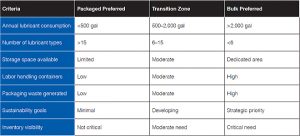
The Bulk Delivery Readiness Matrix turns this decision into a quick, structured self-assessment. For each of the seven criteria, score your operation honestly against the three columns (Packaged Preferred, Transition Zone or Bulk Preferred) and note where most of your answers land.
The seven criteria capture the factors that most influence the format decision: annual lubricant consumption, number of lubricant types, available storage space, labor spent handling containers, packaging waste generated, sustainability goals and the need for inventory visibility. Together they balance hard economics against operational realities and strategic priorities.
Once you’ve scored all seven, read the pattern of your answers:
• Mostly left column: Packaged products remain the best fit for your operation today.
• Mostly center: You’re in the transition zone. A hybrid approach (bulk for high-volume core products, packaged for the rest) likely makes the most sense.
• Mostly right column: Your operation is signaling readiness; a formal bulk assessment is recommended.
A scattered result is just as useful as a clear one. If your scores are split, it usually means a hybrid program will serve you best: moving your highest-volume, most-standardized lubricants to bulk while keeping specialized or low-turnover products in packaged form.
If your readiness assessment points toward the transition zone or bulk, an AMSOIL Industrial Applications Engineer can help you model the total cost of ownership for your facility, design the right contamination controls and map a phased transition that minimizes disruption. The goal is simple: the right product, in the right format, delivered the right way.
Five signals it may be time to reassess
Even without scoring the full matrix, a few everyday signals often reveal that your current delivery method has outgrown your operation:
1. Empty containers are piling up. Growing stacks of drums and pails awaiting disposal point to rising waste and handling costs.
2. Oil changes and top-offs are increasing. Rising frequency across more machines makes case-by-case buying inefficient.
3. Storage space is filling with packaging. When containers crowd out usable floor space, a centralized tank may reclaim it.
4. The wrong product keeps getting grabbed. Frequent mix-ups or near-misses signal too many SKUs and not enough control.
5. You’re running 24/7 and can’t afford to run out. When uptime depends on always having fluid on hand, bulk supply security pays off.
Frequently asked questions
How do I know if bulk lubricants are right for my facility?
Start with volume and variety. If you consistently use more than 2,000 gallons a year of a handful of core products, have space for a tank and are spending real labor handling containers, you’re likely a strong bulk candidate. The Bulk Delivery Readiness Matrix above gives you a structured way to confirm it.
Does bulk delivery mean I have to convert every lubricant?
No. Most facilities are best served by a hybrid program: moving high-volume, standardized products to bulk while keeping specialty or low-turnover lubricants in packaged form. You can transition one product line at a time.
Is bulk storage cleaner or dirtier than drums?
It can be either. A closed bulk system with proper breathers, filtration and FIFO discipline is typically cleaner than repeated open-pours from drums. Without those controls, however, a tank can amplify a contamination problem. Cleanliness depends on the controls, not just the format.
What’s the biggest mistake operations make with this decision?
Judging it on price per gallon alone. The format that looks cheapest on the invoice can cost more once handling labor, packaging disposal and contamination-driven downtime are included. Always evaluate on total cost of ownership.
About this guide: Lubrication Logic is written by our technical lubrication team, drawing on field experience helping industrial operations design and manage lubrication programs. Recommendations reflect widely recognized industry best practices for lubricant storage, handling and contamination control. Because every facility is different, use this guide as a starting framework and consult a qualified lubrication specialist before making equipment or supply changes.
| *Technical properties are general characteristics of the product and not manufacturing specifications. Variations that do not affect product performance should be expected. Product formulations are subject to change without notice. Customers are responsible for determining product suitability for use with their equipment. |