
Hydraulic systems are often described as closed, which creates a dangerous misconception: “closed” does not mean impermeable under pressure. Yet plant data consistently shows the opposite. As operating pressures rise, oil contamination accelerates, wear rates increase and hydraulic component life drops sharply. This trend is well-documented across injection molding, metal stamping, power generation and other pressure-intensive industries.
So, what’s really happening inside these systems?
The answer is not outside dirt intrusion alone — it’s pressure-driven contamination generated inside the system itself.
Pressure Doesn’t Introduce Contamination — It Creates It
Oil degradation and wear accelerate as pressure increases, directly reducing component service life. Technical consensus confirms that 70 – 90% of hydraulic system failures are contamination-related, with pressure as a key multiplier.
Closed hydraulic systems may prevent external dirt intrusion, but they aren’t contamination-free ecosystems. Increased pressure amplifies internal mechanisms that generate contamination within the oil. As pressure rises, metal surfaces in pumps, valves and actuators experience higher contact stress. This intensifies wear mechanisms such as abrasion, fatigue cracking and surface spalling, producing fresh metal particles that circulate and cause further damage.
Pressure doesn’t just move oil — it changes how oil, air, water and metal behave at the microscopic level.
How High-Pressure Drives Contamination Growth
As hydraulic system pressure increases, a cascade of internal contamination mechanisms emerges — each interconnected and compounding the effects of the others. Elevated pressure not only accelerates the generation of wear particles, but also mobilizes particles already inside the system, making previously settled debris and soft deposits more likely to re-enter circulation. The following points illustrate how elevated pressure triggers wear particle generation, air and water release, additive depletion and seal deformation. Together, these processes drive contamination growth even in so-called “closed” systems, ultimately affecting component reliability and operational longevity.

1. Accelerated Wear Particle Generation
As pressure increases, clearances tighten and contact stress rises at pumps, valves and actuators. This causes:
• Abrasion of surfaces.
• Surface fatigue and micro-cracking.
• Fatigue spalling in high-load zones.
These wear mechanisms create new metal particles continuously, which then circulate and cause secondary damage.
2. Pressure-Induced Air Release and Micro-Dieseling
Hydraulic oil contains dissolved air— typically up to 9–10% by volume. Under pressure fluctuations:
• Air is compressed and released.
• Bubbles collapse violently in high-pressure zones.
• Localized temperatures spike.
This process, called micro-dieseling, rapidly oxidizes oil and generates carbon byproducts that behave like hard abrasive contaminants.
3. Water Release and Additive Depletion
Higher temperature increases oil’s ability to hold dissolved water, but pressure changes (especially rapid drops) and contamination can still drive water out of solution. The result:
• Free or emulsified water formation.
• Corrosion and rust particle generation.
• Additive depletion and sludge formation.
These contaminants often go unnoticed until valves begin sticking or pumps fail prematurely.
4. Seal Deformation and System “Breathing”
Even sealed systems must equalize pressure, and “closed” does not mean perfectly sealed at every microscopic interface. As pressure rises and cycles, it can force contaminants through microscopic gaps at breathers, fittings, rod seals and other interfaces that would appear leak-free at lower pressures. During pressure cycling:
• Reservoirs breathe through desiccant breathers (and any weakness here becomes a direct pathway).
• Rod seals deform under load — and deformation, wear and material permeation increase as pressure rises.
• Minute clearances open briefly during motion — and repeated pressure cycling can act like a pump, accelerating contamination ingress over time.
The result is that high pressure (and especially pressure cycling) can pull or push moisture vapor and fine airborne particles past sealing surfaces and through microscopic pathways — particularly in humid or dusty manufacturing environments.
Why High Pressure Shortens Hydraulic Component Life
Cleanliness targets become more stringent as pressure rises. AMSOIL Industrial documentation shows that hydraulic systems operating above 3,000 psi require ISO cleanliness levels as tight as 15/13/10, often demanding 3-micron filtration.
Even a one-number increase in ISO cleanliness code represents a doubling of particle count.
To illustrate, imagine a plastics injection molding plant running hydraulic presses at 3,500 psi. If the ISO cleanliness code slips from 15/13/10 to 16/14/11 — just a single number higher — the oil now contains twice as many contaminant particles. These extra particles can quickly abrade pump surfaces, clog valve clearances and accelerate seal wear, leading to costly downtime and premature equipment failure. In this environment, even microscopic debris becomes a major threat, making strict filtration and proactive monitoring essential for reliable operation.
Practical Solutions for High-Pressure Systems
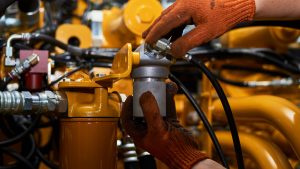
For operations in plastics, metalworking, pulp & paper, power generation and wind energy, controlling pressure-driven contamination requires a systems approach:
• Start with certified clean oil, not “as-filtered” bulk fills.
• Upgrade filtration as pressure increases, not just when failures occur.
• Monitor ISO cleanliness trends, not just wear metals.
• Control air and water with proper breathers and reservoir design.
• Use oil analysis proactively, not reactively.
Key Takeaways for Decision Makers
• Hydraulic systems are closed — but not static.
• Pressure amplifies internal contamination mechanisms.
• Most contamination is self-generated, not externally introduced.
• Small increases in cleanliness dramatically extend equipment life.
• Pressure cycling can turn tiny sealing imperfections into repeatable pathways for contamination ingress.
• Waiting for failure is far costlier than controlling contamination.
How AMSOIL Industrial Can Help
AMSOIL Industrial supports pressure-intensive operations with:
• Advanced contamination-control strategies.
• Lubricant and fluid analysis programs.
• Application-specific technical support.
If your facility is pushing higher pressures to increase output, controlling oil cleanliness is no longer optional — it’s foundational to reliability.
Turn contamination control from a maintenance expense into a competitive advantage. Contact an AMSOIL Industrial Application Engineer today.
| *Technical properties are general characteristics of the product and not manufacturing specifications. Variations that do not affect product performance should be expected. Product formulations are subject to change without notice. Customers are responsible for determining product suitability for use with their equipment. |